Every founder eventually runs into TAM, SAM, and SOM — usually for the first time when they're filling out a pitch deck and realize they have no idea what to put in the "market size" slide. So they go find a market research report, multiply some numbers, and end up with a TAM of $47 billion for a product that might realistically serve a few thousand customers.
That version of the exercise is useless. Investors see through it in ten seconds, and — more importantly — it doesn't help you make any decisions about whether to build the product.
The version that's actually useful is different. Instead of impressing anyone, it forces you to be honest about who your customer actually is, how you'll reach them, and how much money is realistically on the table in the first three years. Done right, TAM SAM SOM is one of the sharpest tools for sanity-checking whether you're about to spend two years building something that has no real business underneath it. Sizing is one half of market validation; the other half is confirming buyers will actually pay and that the market's structure leaves room for you.
Want a bottom-up TAM/SAM/SOM for your specific idea? Run it through Scoutr's discovery flow →
What TAM, SAM, and SOM Actually Mean
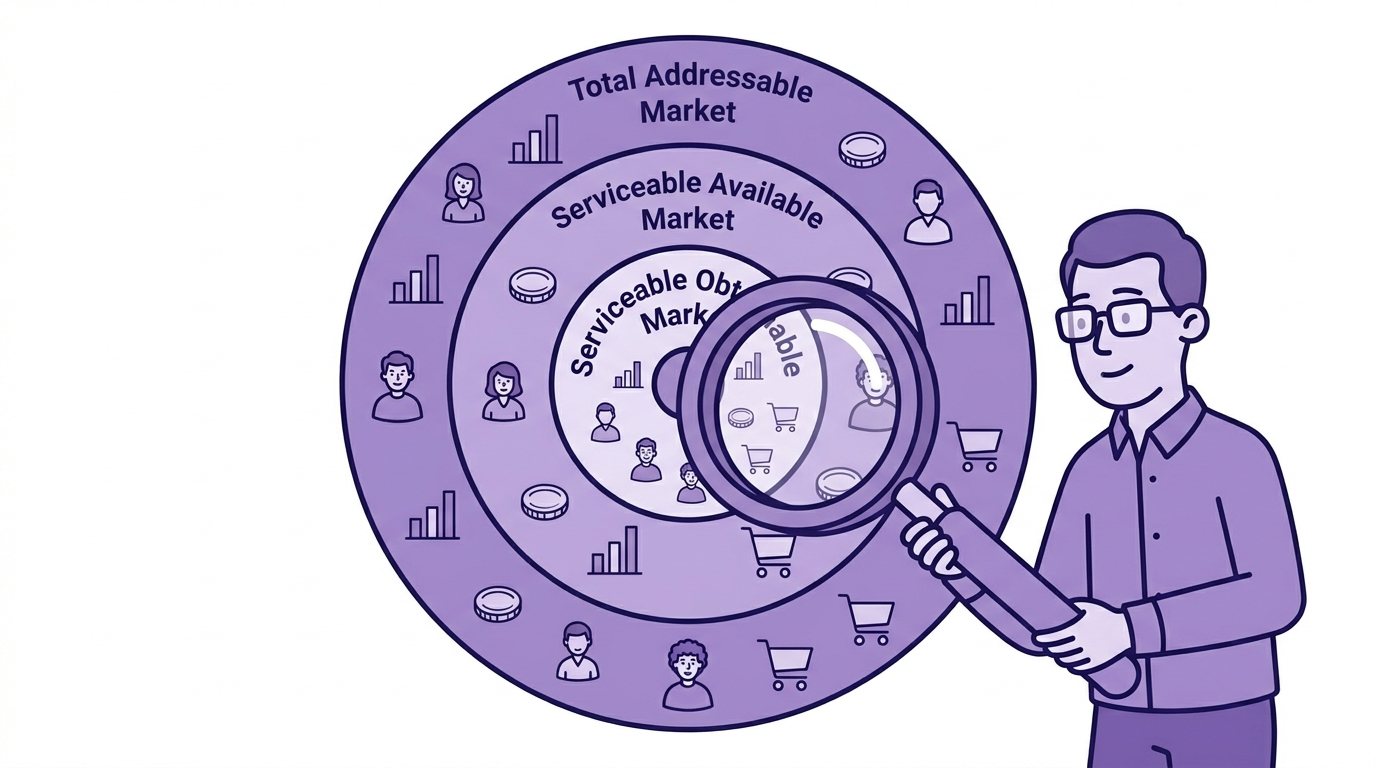
TAM — Total Addressable Market. The total annual revenue opportunity if every single person or business who could theoretically use your product bought it at your price. In other words, the biggest possible version of the market. TAM marks the ceiling rather than the plan.
SAM — Serviceable Addressable Market. The portion of TAM you could realistically target given your actual product, business model, geography, and channel. If you sell in English only, your SAM doesn't include non-English-speaking markets. If you're B2B SaaS and you target small-to-medium businesses, your SAM doesn't include enterprise or solo users.
SOM — Serviceable Obtainable Market. The portion of SAM you can realistically capture in the near term — typically the next one to three years. This is the number that matters most for operating decisions. It tells you whether there's enough business to sustain the company while you grow.
The concentric-circle model is standard: SOM sits inside SAM sits inside TAM. Each one is a narrower, more realistic slice of the one above it.
The Mistake Most Founders Make
The classic mistake is calculating TAM/SAM/SOM top-down.
Top-down goes like this: you find a market research report that says "the global CRM market is worth $80 billion." You pick some arbitrary percentage — "we'll capture 1% of this market" — and you put $800 million in your SOM box. Done.
This is the version everyone recognizes as obviously bad. The "1% of a big number" approach has no basis in reality, doesn't account for how you'd actually reach customers, and is usually off by orders of magnitude once you try to execute against it.
But there's a subtler version of the same mistake that's harder to spot. You find a narrower, more credible-sounding market report — "the US market for AI coding tools for mid-sized teams is $2.1 billion" — and you do the same multiplication, just with smaller numbers. It still doesn't work. The problem isn't the size of the starting number. It's that you're starting with somebody else's aggregation and hoping it maps onto your specific product, positioning, and distribution.
It almost never does.
The Bottom-Up Version That Actually Works
Bottom-up TAM/SAM/SOM starts with a single customer and builds up.
Start here: how many of this specific type of customer exist? Not "SMBs" — too vague. Something like "US-based dental practices with 3 to 15 employees who use Dentrix for scheduling." You can count those. Industry data, LinkedIn, trade associations, and SEC filings will get you a real number.
Then answer: what would one of them pay per year for what you're building? Not aspirationally. Based on what they already pay for adjacent tools, or what they currently spend on the workaround. If they're currently paying $200/month for a worse solution, you have a reference point. If they're not paying for anything, the number starts much lower, no matter how useful your product is.
Multiply those two numbers and you have a real TAM — one built on counted customers and referenced pricing, not on a market report's aggregation.
Your SAM is the slice of that TAM you can realistically reach given your sales model. If you're doing product-led growth through SEO and content, you can only reach customers who search online. If you're doing outbound sales, you're limited by how many conversations your team can have. If you're selling to a niche that doesn't use the internet heavily, your SAM is much smaller than your TAM.
Your SOM is honest. It's the customers you can actually win in year one given your channels, your pricing, and the competition you're fighting for attention. For most early-stage products, SOM is 1–5% of SAM in the first year, growing over time as distribution matures.
A Concrete Example
Let's walk through one. Say you're building a scheduling tool for independent music teachers.
Bottom-up TAM. There are roughly 120,000 independent music teachers in the US who teach privately. A realistic annual price point for a tool like yours — based on what Acuity and similar schedulers charge — is around $180/year. Bottom-up TAM: 120,000 × $180 = $21.6M/year.
SAM. You can't reach all 120,000. You're focused on music teachers who are online enough to find you through content or Meta ads — probably 60% of the total. You also only serve US teachers initially. SAM: ~72,000 × $180 = $12.9M/year.
SOM. Your plan is SEO + partnerships with music schools, and you expect to capture a small share of the reachable market in year one. Realistic year-one capture: 2% of SAM. SOM year one: ~1,440 customers × $180 = ~$260K ARR.
Now ask yourself the actually useful question: is $260K ARR in year one a real business? Can you get to $1–2M ARR by year three at that customer acquisition pace? If yes, this is a viable venture (for you, at your stage). If no, you either need a higher price point, a different segment, or a different business entirely.
The exercise exists to drive that decision, not to fill a pitch deck slide.
Why SOM Matters More Than TAM
Every pitch deck has a huge TAM. It's the easiest number to inflate and the least meaningful.
SOM is where the real constraint lives. SOM tells you whether your unit economics work, whether you can afford to pay yourself in year two, whether your CAC (customer acquisition cost) will eat your margins alive, whether you'll need to raise capital or can bootstrap.
When you calculate SOM honestly, one of two things happens:
The number is big enough. Your SOM in year one supports the company you want to build. The math works. You can move to execution with confidence that there's a real business at the end of the tunnel.
The number is too small. Your SOM in year one is $50K ARR against $300K of expenses. That doesn't mean the product is a bad idea. But it means your current plan — that specific combination of target customer, price point, and channel — doesn't support a business. You need to change one of those variables: a different segment with higher willingness to pay, a different pricing model, a different distribution channel, or a product that addresses a larger problem.
Many founders find out the hard way that their SOM is too small, after building for twelve months. The exercise is meant to surface that before you commit.
Common Mistakes in Market Sizing
Confusing "could use this" with "would pay for this." TAM is about paying customers, not potential users. A free product has a huge addressable market and zero TAM.
Using global numbers when you can only reach one country. If you can't localize, support, or legally sell in a market, it's not part of your TAM. Cut ruthlessly.
Pricing too optimistically. Your TAM is whatever customers will actually pay, not what you hope they'll pay. If you haven't tested pricing yet, use comparable products' pricing, not your ambitious pricing.
Treating SOM as a target instead of a forecast. SOM is a realistic estimate of what you'll capture, not a goal you've committed to. If your SOM is ambitious, it's wrong.
Leaving out CAC. A SOM of $1M ARR sounds great until you realize your CAC is $3,000 per customer and your ACV is $200. Market sizing without unit economics is incomplete.
Not updating as you learn. TAM/SAM/SOM is not a one-time calculation. Every customer conversation — every data point about pricing, conversion, and channel performance — should refine it. The number should get sharper over time, not stay frozen in the pitch deck.
How This Fits With Customer Conversations
Market sizing is a quantitative exercise, but the inputs are qualitative. You don't know what customers will actually pay until you talk to them using the Mom Test and ask specifically what they currently spend to solve this problem. You don't know how reachable they are until you've tried to reach a few. You don't know the real price point until you've tested it with people who might actually buy.
The founders who get TAM/SAM/SOM right tend to be the ones who've already done real validation conversations before running the numbers. They have reference points. They know which assumptions are load-bearing and which are soft. Their numbers survive contact with reality because they were built from contact with reality in the first place.
The founders who get it wrong tend to work in the opposite direction: build a market size from reports, then try to find customers that fit it. That process is designed to produce optimistic numbers and unpleasant surprises.
What Market Sizing Tells You About Your Business
After a clean bottom-up calculation, you'll know three things:
- Whether the business can work at all. Is SOM year one big enough to sustain the company? Can SOM year three justify the effort?
- What your first channel has to look like. SOM is a function of how you reach customers. If your SOM is too small, the fix is usually in distribution, not product.
- What your pricing strategy needs to be. If SOM doesn't clear your costs at current pricing, you need either a higher price point or a different customer segment. That decision is clearer once the numbers are real.
TAM tells you whether the market is big enough to care about. SAM tells you whether your version of the market is reachable. SOM tells you whether you have a company. Most founders obsess over TAM and ignore SOM, when the priority should run the other way.
If you want a structured way to pressure-test the numbers behind your idea — including TAM/SAM/SOM sizing grounded in real demand signals from Reddit and competitor data — Scoutr runs that analysis as part of its discovery report. It won't replace the customer conversations you need to do. But it gives you a defensible starting point built from real data instead of optimism.