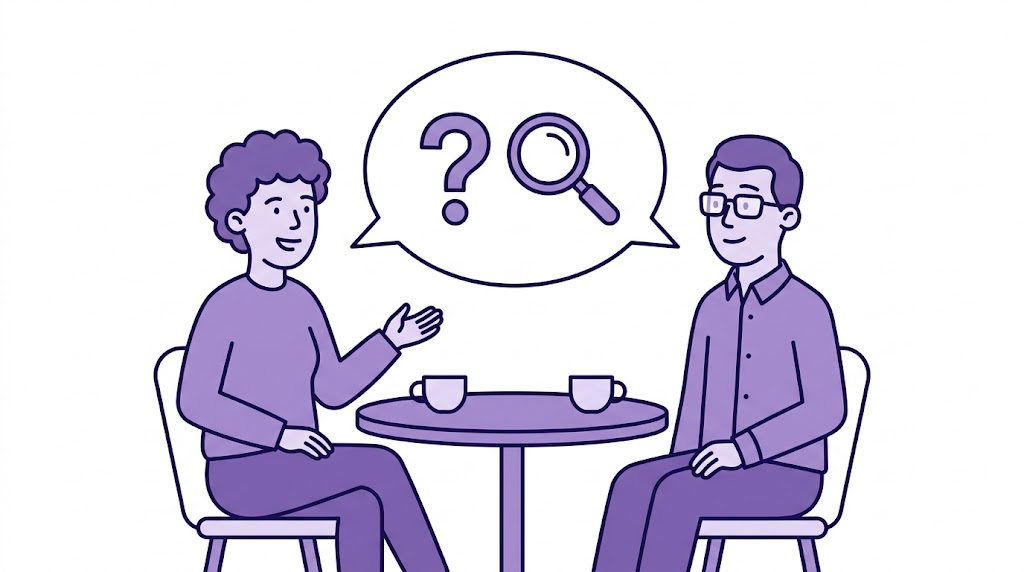
The Mom Test exists because most founders have conversations with potential users and come away thinking they've validated their idea, when what they collected was polite agreement from people who did not want to hurt their feelings.
The Mom Test is a framework for fixing that. It was developed by Rob Fitzpatrick and published in a short, sharp book of the same name. The core premise is simple: if you describe your startup idea to your mom, she'll tell you it's great because she loves you, which has nothing to do with whether it is a good idea. Most founders, without realizing it, structure their conversations with everyone the same way they'd talk to their mom. They ask leading questions. They describe their solution. They telegraph what answer they're hoping to hear.
The result is warm, encouraging conversations that contain almost no useful information.
Why You're Probably Asking the Wrong Questions
The failure mode has a clear shape. Founders ask questions that are easy to say yes to:
- "Do you think this is a good idea?"
- "Would you use something like this?"
- "Would you pay for a tool that did X?"
These questions feel like validation research, but they work as social prompts. The socially comfortable answer is almost always yes, especially when the person being asked can see how much you care about the answer.
People are not lying; the questions simply do not ask for anything honest. When you ask "would you use this?", their brain does not simulate their future behavior, it checks whether agreeing would be socially awkward. And disagreeing with someone who's clearly excited about their idea is awkward.
This is why you can talk to thirty people, have thirty encouraging conversations, build the product, launch it, and hear nothing.
The Three Rules of the Mom Test
Fitzpatrick distills the framework into three rules that apply to every customer conversation:
1. Talk about their life, not your idea.
The fastest way to corrupt an interview is to describe what you're building. The moment you do, the conversation shifts. Now they're reacting to your solution instead of describing their problem. They're trying to be helpful, to find angles where your idea could work, to give you useful feedback. None of that is what you need.
What you need is to understand their current reality: the problem, the friction, the workarounds. That's information you can only get if you're not steering them toward a solution they know you're invested in.
2. Ask about specific events in the past rather than generic opinions about the future.
"Would you" and "do you" are weak questions. They ask for speculation about behavior, which is unreliable.
"Tell me about the last time this happened" is a strong question. It asks for a memory, and memories are concrete: the tool they used, the workaround they built, the frustration they felt. You can learn more from one real past incident than from twenty hypothetical opinions about the future.
3. Listen more than you talk.
This is the one founders get wrong in practice even when they understand it in theory. You want to hear the user talk 80% of the time. Every time you fill a silence or explain something or jump in with clarification, you're reducing the chance they'll say something you didn't expect, and the unexpected is the only part worth the meeting.
What Good Mom Test Questions Look Like
The shift from bad to good questions is not subtle once you know what to look for.
| Bad question | Good question |
|---|---|
| "Would you use a tool that automated X?" | "How do you handle X right now?" |
| "Do you think this problem is annoying?" | "Tell me about the last time this came up." |
| "Would you pay $30/month for this?" | "What are you currently spending to solve this?" |
| "Do you see yourself using this weekly?" | "Walk me through your workflow for this last week." |
| "Is this something your team struggles with?" | "What did your team do last time this was a problem?" |
The right column doesn't mention your idea. It asks instead for behavioral evidence, meaning what people do, what they pay and what they put up with, which is the only kind that predicts whether your product gets used.
24 Questions That Pass the Mom Test
Grouped by what you are trying to learn. Pick five or six per conversation rather than working through the list, because an interview that feels like a survey stops producing honest answers.
To find out whether the problem is real
- How do you handle this today?
- Tell me about the last time this came up.
- How often does that happen?
- What did you do about it?
- Who else was involved when it happened?
- What happened after that?
To find out how much it costs them
- How long did that take you?
- What does it cost when it goes wrong?
- Are you paying for anything to deal with this right now?
- Is anyone on your team spending time on this?
- What would need to be true for this to become a priority?
- Where does this sit against the other things on your list?
To find out what they have already tried
- What have you tried before?
- Why did you stop using it?
- What did you like about it?
- What would have had to change for you to keep paying for it?
- Have you ever looked for something to fix this?
- What did you search for when you looked?
To find out whether they will actually buy
- Who would have to approve a purchase like this?
- What is the budget this would come out of?
- What happened the last time your team bought a tool like this?
- Can I come back to you when I have something to show?
- Would you be willing to put down a deposit to hold a place?
- Is there anyone else who deals with this that I should talk to?
Question 24 matters more than its position suggests. A conversation that ends with two introductions compounds, and a conversation that ends with a thank-you does not.
Questions 19 through 23 are the ones founders skip, usually because asking about money feels like selling. In B2B they are the questions that separate a real buyer from an enthusiastic user who cannot authorize anything.
The Insight Most Summaries Miss
Most summaries of the Mom Test stop at question structure. The larger shift is in what you are trying to find out.
When most founders run customer interviews, they're trying to find out whether their idea is good. The Mom Test asks you to forget your idea entirely and instead try to understand someone else's problem as completely as possible.
That is a different goal, and it changes which questions you ask, which silences you let sit, and what you count as a useful answer.
When you're trying to validate your idea, you unconsciously steer the conversation. You follow up on things that confirm your hypothesis. You move quickly past things that don't. When you're trying to understand their life, you follow wherever the conversation leads, because any honest detail is useful.
This is why the Mom Test works for the founders who internalize it rather than the ones who memorize the templates.
Common Mistakes
Describing the product before asking questions. Even a brief description poisons the conversation. If you've said "I'm building a tool that does X," every answer they give is shaped by that framing. Save the description for after you've exhausted your questions.
Counting enthusiasm instead of evidence. Someone who says "this is exactly what I've been looking for" is less useful than someone who says "I spend six hours a week on this in a spreadsheet I built myself." The enthusiasm costs them nothing to say; the six hours a week is evidence.
Stopping at surface-level answers. If someone says "yeah, that's annoying," follow up. "When did it last come up? What did you do about it? How long did that take?" The surface answer is almost never the useful one. The third follow-up usually is.
Asking about a problem you haven't confirmed exists yet. You can't run a useful Mom Test conversation about a problem your interviewee doesn't have. Before you ask how they handle it, make sure you've confirmed it's actually something they experience.
Ending without asking who else to talk to. Every good interview should end with: "Is there anyone else you know who deals with this? Would you be willing to introduce me?" This is often more valuable than the interview itself.
What You're Looking For
A successful Mom Test conversation leaves you with:
- A description of the last time the problem came up, covering what happened, what they did and how long it took
- A clear picture of the current workaround, whether that is a tool, a manual process, or someone they pay
- A cost attached to the problem, in time or money or both
- Emotional language such as "it drives me crazy" or "I've been looking for something better for years", which tells you how much the problem weighs on them
These are the demand signals that tell you a problem is real: evidence that it hurts enough for people to already be spending time or money on it, however imperfectly.
If you finish five conversations and can't describe a specific, consistent workaround that real people are using right now, that's important information. It doesn't necessarily mean the problem doesn't exist, since you might be talking to the wrong people or asking questions that aren't surfacing the behavior. But it means you need to keep looking before you start building.
How Many Conversations You Need
Fitzpatrick suggests that three to five conversations with people from the same narrow segment is usually enough to find the patterns, or to realize you don't have a clear enough target. If after five conversations you're hearing completely different problems from everyone, the issue is usually that your target user definition is too broad.
Five conversations with the same job title, the same company size and the same context will tell you more than fifty across a vague category of people.
About the Book, and Whether to Read It
Rob Fitzpatrick published The Mom Test in 2013. It runs about 130 pages, most of which are transcripts of real customer conversations with a running commentary on where each one went wrong.
That structure is the reason to read it rather than a summary. The rules compress into a page, which is what this article is, but watching a founder in a transcript talk themselves into a false positive over four exchanges teaches something the rule alone does not. You recognize the move afterward because you have seen it happen.
It takes about two hours. If you have customer conversations booked this month, it is worth the two hours. If you are still deciding whether to have them, start with the three rules above and book the conversations first.
Running the Mom Test as Part of a Larger Discovery Process
The Mom Test gives you the conversational layer. But it's one part of a fuller validation process that also includes community research, demand signal analysis, and competitive intelligence. It's also the most reliable of the validation methods available, alongside smoke tests and concierge MVPs, but knowing where it sits among the others keeps you from leaning on it alone.
Conversations tell you the depth of the problem. Search volume tells you the breadth. Competitor analysis tells you whether the market already has a solution and why it is failing. The product discovery framework that covers all six of those dimensions gives you the complete picture.
What the Mom Test adds is the room itself: one person who has the problem, and an hour in which you are not allowed to filter their reality through your assumptions. Most founders skip that hour.
If you want a structured way to prepare, knowing which gaps to probe and which questions to prioritize for your idea, Scoutr generates a set of Mom Test questions tailored to your problem space as part of its discovery analysis. It won't replace the conversations. But it will make sure you're asking the right ones.