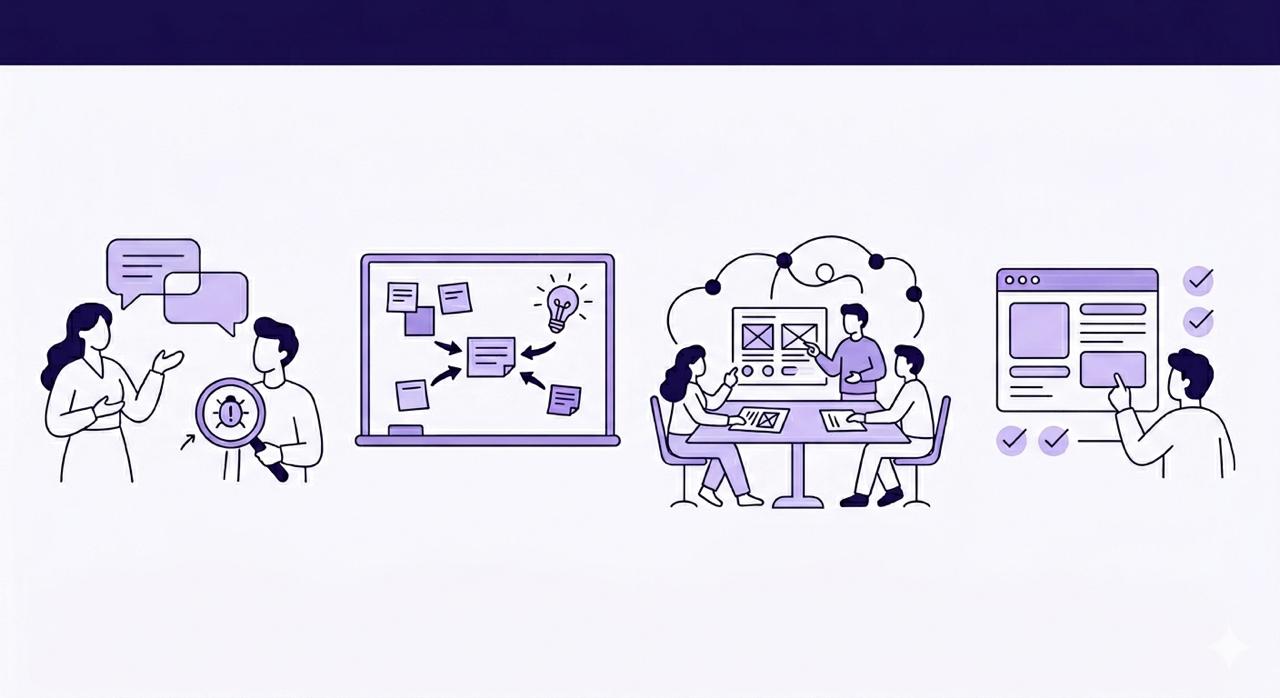
Product discovery is the work of figuring out what's worth building before you build it. It covers understanding who the customer is, what problem they actually have, how they're solving it today, and what evidence suggests they would adopt — and pay for — something better. Delivery is building the thing right; discovery is making sure it's the right thing.
The term comes from the product management world, and most writing about it assumes you have a product team, a research repository, and quarterly OKRs. This guide covers the concept fully but keeps returning to the scale where discovery matters most and gets skipped most: one founder, one idea, savings on the line.
Why Discovery Exists
Post-mortem research on failed startups keeps finding the same leading cause of death: building something nobody needed. Not bad engineering, not slow shipping — wrong target. CB Insights' long-running analysis puts "no market need" at the top of the failure-reason list, and anyone who has launched to silence knows the feeling behind the statistic.
Discovery exists because building is so absorbing that it crowds out asking whether the build is aimed correctly. Code produces visible progress every day. Discovery produces uncomfortable questions. Under deadline pressure or founder enthusiasm, visible progress wins, and the result is the most expensive way to learn that the answer was no.
The economic case is brutal in its simplicity: a discovery pass costs one to three weeks. Building an MVP costs three to six months. When discovery kills an idea, it refunds you a season of your life.
Discovery vs. Validation vs. Research
Three terms that get blurred:
Product discovery is open-ended exploration of the problem space. What problems does this customer have? Which are painful enough to matter? What would a solution need to look like? Discovery generates and shapes candidates.
Validation is closed-ended testing of a specific candidate. Given this idea, does the evidence support building it? Our idea validation framework covers that side, and seven validation methods ranks the techniques.
Market research is the traditional, top-down cousin: market sizing, segmentation, trend reports. Useful for investors and TAM/SAM/SOM estimates, but it describes markets in aggregate, while discovery studies specific humans and their behavior.
In real work the three interleave. Discovery surfaces a candidate, validation filters it, and both borrow research when sizing matters. The sequence that fails is doing none of them and calling the MVP "our validation."
The Product Discovery Process: Four Phases
Phase 1: Frame the Riskiest Assumption
Every idea rests on a stack of assumptions: the problem exists, it's painful, these people have it, they'd switch, they'd pay. Discovery starts by naming the assumption that kills the idea fastest if wrong. For most early-stage ideas that's problem existence or willingness to pay, almost never usability or technology.
Phase 2: Study Current Behavior
Before talking to anyone, look at what the market already does. Existing alternatives and their pricing, community complaints (Reddit threads, forum posts, review-site one-stars), and above all workarounds — the duct-tape solutions people build when nothing serves them. Workarounds are the highest-grade ore in discovery: someone annoyed enough to build a spreadsheet monster is someone with a real problem. Our guide to demand signals catalogs what to look for.
Phase 3: Talk to the People
Five to ten conversations with people who live the problem, run as behavioral interviews: what they did last time the problem occurred, what it cost them, what they've already tried. The discipline of asking about the past instead of pitching the future comes from the Mom Test, and it's the difference between data and flattery. Patterns across five strangers outweigh enthusiasm from fifty friends.
Phase 4: Test Demand Cheaply
Before building the product, test the decision: a landing page with a real price, a concierge version delivered manually, a pre-order offer. Each one converts opinions into behavior. If nobody clicks, signs, or pays at this stage, the product version won't change that — the assumption from Phase 1 just failed, cheaply, which is discovery doing its job.
The four phases are the work. The six questions below are what you should be able to answer when the work is done.
A Product Discovery Framework for Founders: Six Questions
Most product discovery frameworks are designed for product managers at established companies, with sprint cycles, research repositories and cross-functional alignment meetings. Before you have a team, a roadmap or a product, the question is whether the idea is worth building at all, and the framework that answers it has to be cheap, fast, and honest about what you actually know. This one draws from three sources: Rob Fitzpatrick's The Mom Test, YC's advice to founders at the earliest stage, and Eric Ries's The Lean Startup. Six questions is the minimum needed for a complete picture without turning discovery into a research project.
1. Who specifically has this problem?
Not "small businesses." Not "busy professionals." One specific person: their job title, their company size, their daily context, and why this problem comes up for them. If you can't describe one real person who has this problem, what you have is a hypothesis to test rather than a target user. Start there.
2. How are they solving it today?
The most important question in the framework. If the problem is real and painful, people are already doing something about it. They have a workaround, they pay for an imperfect solution, or they run a manual process they hate. Those workarounds are evidence: the problem is real (they're motivated enough to work around it), there's a market (they're already spending time or money), and there's an opening (the current solution isn't good enough). The more painful the workaround, the stronger the signal.
3. Have you talked to someone with this problem?
Not "would someone have this problem?" Have you actually had a conversation with a real person who experiences it? Did they describe it without prompting, in specific and emotional language? This question exists to force the distinction between assumption and evidence. The bar isn't one conversation; it's five. One person ranting about it could be a bad day. Five people independently describing the same pain is a pattern worth building around.
4. Is anyone already paying to solve this?
Money is the hardest signal to fake. If people currently pay for a competitor, for manual labor, or for a workaround, you know the problem is worth paying to solve, and the question becomes whether you can solve it better. If nobody pays anything to address it, ask why. Sometimes the problem isn't painful enough. Sometimes no solution exists yet. Those are different situations. The clearest version of this signal is a line item on someone's company card: a SaaS subscription, a contractor invoice, a freelancer retainer.
5. What would they do if your solution disappeared?
A future-tense version of the workaround question. If the answer is "nothing" or "I guess I'd go back to doing it manually," the problem isn't acute enough. If the answer is "I'd have to hire someone," "our whole process would break," or "I'd look for an alternative immediately," the problem creates real urgency.
6. Why you?
The real question is whether you have unfair distribution or unfair insight. Knowing the 50 people with this problem and being trusted by them already counts as unfair distribution. Four years inside the workflow and seeing the gap nobody else has noticed counts as unfair insight. "I'm passionate about productivity" doesn't. Without one of those you can still build, but you're starting without a moat and the next year of your life will be about earning one.
How to use the six questions
Run through them twice. On the first pass, answer each with what you currently know and mark every answer where you're speculating rather than reporting evidence. Those marks are your research priorities. On the second pass, after two weeks of interviews, community research and competitor analysis, the gaps should be smaller. If they're not, that's useful information too.
Founders who run the framework for the first time usually discover they can't answer question 3. They've never talked to someone with the problem. That is the most common failure mode in early-stage product work, and exactly where to start. Scoutr runs the six questions as a conversation, challenges weak answers, and returns a structured report covering all six areas plus competitive signals and market sizing.
The dog toy and the plastic bottle
A picture of what question 2 looks like in the wild. An $18 dog toy with crinkle material and a squeaker sat untouched in the basket while the dog spent forty minutes with an empty plastic bottle off the floor. The bottle is the workaround: ugly, unplanned, and one of the most reliable demand signals available before a line of code exists. The spreadsheet someone maintains and hates, the tool being hacked to do something it wasn't designed for, the Reddit thread asking whether anyone else manages this by hand: those are the bottles. If the problem is real, the bottle is already there. Someone is already solving it badly, and your job is to find it.
The subtle version of the mistake is finding the bottle, understanding the problem, and then building the toy anyway: the right problem solved for slightly the wrong person, at slightly the wrong price, in polished packaging the user never asked for. That is why discovery continues through every design decision, feature choice and pricing conversation after building starts.
Core Discovery Techniques, Matched to Risk
| Riskiest assumption | Technique that tests it |
|---|---|
| "This problem exists and hurts" | Behavioral interviews; community and review mining |
| "People want it solved badly enough" | Workaround analysis; existing-spend research |
| "They'd pay for a solution" | Pre-sales; smoke tests with prices; WTP research |
| "They'd switch from the incumbent" | Competitor teardown; churn-review mining |
| "They can use what we'd build" | Prototype tests; concierge MVP |
The table is the discipline: pick the technique that attacks your riskiest assumption, not the one that's most comfortable. Founders who love talking run interviews forever; founders who love building ship prototypes to test problems that interviews would have killed in a week. The technique menu with tool recommendations lives in product discovery tools.
Continuous Discovery, and What It Means for Founders
Modern product organizations practice continuous discovery — the habit, popularized by Teresa Torres, of weekly customer contact feeding an ongoing stream of small research bets, rather than a discovery "phase" that ends when building starts.
The founder translation: discovery doesn't end at launch. The idea that survives initial discovery still needs its assumptions re-tested as it meets real users, real churn, and real pricing pressure. The founders who treat discovery as a permanent habit — one conversation a week, one experiment a month — catch product drift while it's still cheap to correct.
Where Founders Get Discovery Wrong
Treating it as a formality. Running two interviews with friends, hearing "cool idea," and proceeding. Discovery only works when it can kill the idea; if no possible finding would stop you, you're doing ceremony, not discovery.
Pitching instead of listening. The moment you describe your solution, every answer afterward is contaminated by politeness. Solutions enter the conversation last or never.
Confusing signal strength. A hundred waitlist emails feel like more than three pre-orders. They aren't. Ranked evidence — behavior over intention, money over words — is the whole trick, and it's why demand signals and willingness to pay get their own guides.
Discovering forever. Discovery has a failure mode in the other direction: research as procrastination. The phases above are designed to end — one to three weeks for a first pass, then a decision.
Running Your First Discovery Pass
If you have an idea on the table right now, the minimum honest pass looks like this: one afternoon mapping existing alternatives and what they charge, one afternoon mining communities for complaints and workarounds, five behavioral interviews across two weeks, and one cheap demand test with a price attached. Then decide.
Scoutr was built to compress the desk-research half of that pass into minutes: it maps the existing alternatives, surfaces demand signals from real communities, sizes the opportunity, and returns an honest verdict on what the evidence supports. Run your idea through a discovery analysis and start your interviews already knowing the landscape.